


AI in Construction: Why Artificial Intelligence Still Can’t Replace On-Site Intelligence
26/11/2025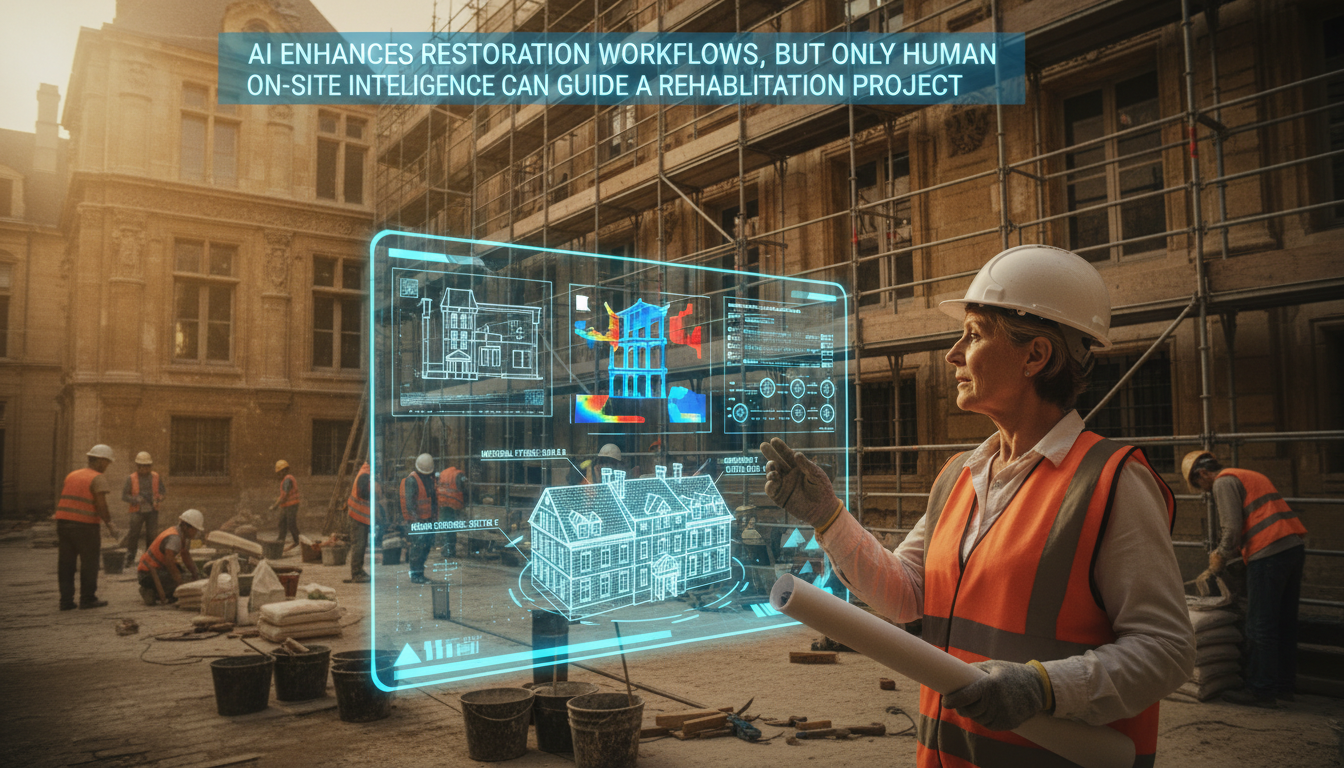
AI in Construction: Why Artificial Intelligence Still Can’t Replace On-Site Intelligence
Keywords principales: AI in construction, construction management, site management, chantier, project supervision, construction productivity, digital transformation in construction.
Artificial intelligence is transforming workflows across industries—including those traditionally driven by field expertise, like construction. Automated estimates, OCR plan analysis, AI-assisted drafting, and predictive scheduling are becoming standard tools.
Yet on any construction or renovation site, one truth remains: AI cannot replace the human intelligence required to manage a chantier.
Drawing from hands-on experience teaching future site managers, this article explains why AI in construction is powerful but still limited—and why on-site intelligence remains essential.
AI in Construction: A Powerful Tool, But Not a Site Operator
Digital transformation in construction is accelerating.
Students and young professionals in construction management now use AI tools daily to:
-
analyze technical documents and blueprints;
-
structure execution methods;
-
generate technical and contractual content.
These tools boost construction productivity, but they also create a misconception: that AI can solve every organizational challenge on a chantier.
In reality, AI remains an assistant, not a site manager.
Why AI Still Can’t Replace On-Site Intelligence
Even the most advanced models in artificial intelligence cannot:
-
evaluate the real productivity of a construction team based on human dynamics;
-
anticipate reactions to stress, environmental changes, or fatigue;
-
adjust a site schedule in real time based on engagement or absenteeism;
-
detect soft signals essential to site management: team morale, cohesion, leadership cues.
A chantier is a living environment—shaped by human interactions, micro-decisions, and intuition.
No dataset can fully capture that complexity.
Human Expertise: The Core of Effective Construction Management
Skilled professionals—site managers, project supervisors, maîtres d’œuvre—know that successful construction project management relies on:
-
understanding people, not only plans;
-
adapting constantly to conditions on the ground;
-
optimizing resources according to real personalities and local constraints;
-
applying empirical knowledge of trade-specific challenges.
AI in construction can analyze, predict, and suggest.
But it cannot lead a team—or take responsibility for a chantier.
Training the Next Generation of Construction Leaders
For students and young site managers, one lesson is essential as AI becomes commonplace in construction:
AI does not replace human intuition—it supports it.
AI does not replace leadership—it enhances decision-making.
Future construction leaders must learn to combine digital tools with on-site intelligence, not substitute one for the other.
This balance is what defines true modern construction management.
Conclusion: The Future of Construction Lies in Hybrid Intelligence
At BTP CONSEIL, we believe that the industry’s strongest advantage lies in the synergy between technology and people:
AI to accelerate workflows, anticipate risks, and structure complex information.
Human intelligence to interpret reality, manage teams, and adapt in real time.
The future of AI in construction is not replacement—it's augmentation.
And the chantier of tomorrow will perform best where digital innovation meets human expertise.